



Have you ever played a round of golf where everything seemed to happen naturally?
You weren’t thinking about your swing mechanics. You weren’t constantly checking your score or worrying about what might go wrong. You simply saw the shot, made your decision, and swung.
Your attention was on the game in front of you, and your movements felt almost effortless.
Golfers often describe this experience as being in the zone, or experiencing a golf flow state.
It’s a wonderful feeling. And naturally, once you’ve experienced it, you want to know how to get it back.
But here’s something important I tell the golfers I coach: the harder you try to force yourself into the zone, the more likely you are to become preoccupied with whether you’re there.
Instead of focusing on achieving a particular mental state, it’s more useful to develop the habits and conditions that help you become absorbed in playing golf.
In this article, we’ll explore what flow really means, what makes it more or less likely, and how to develop a mental approach that helps you play more freely, whether you’re in the zone or not.
What Is the Golf Flow State?
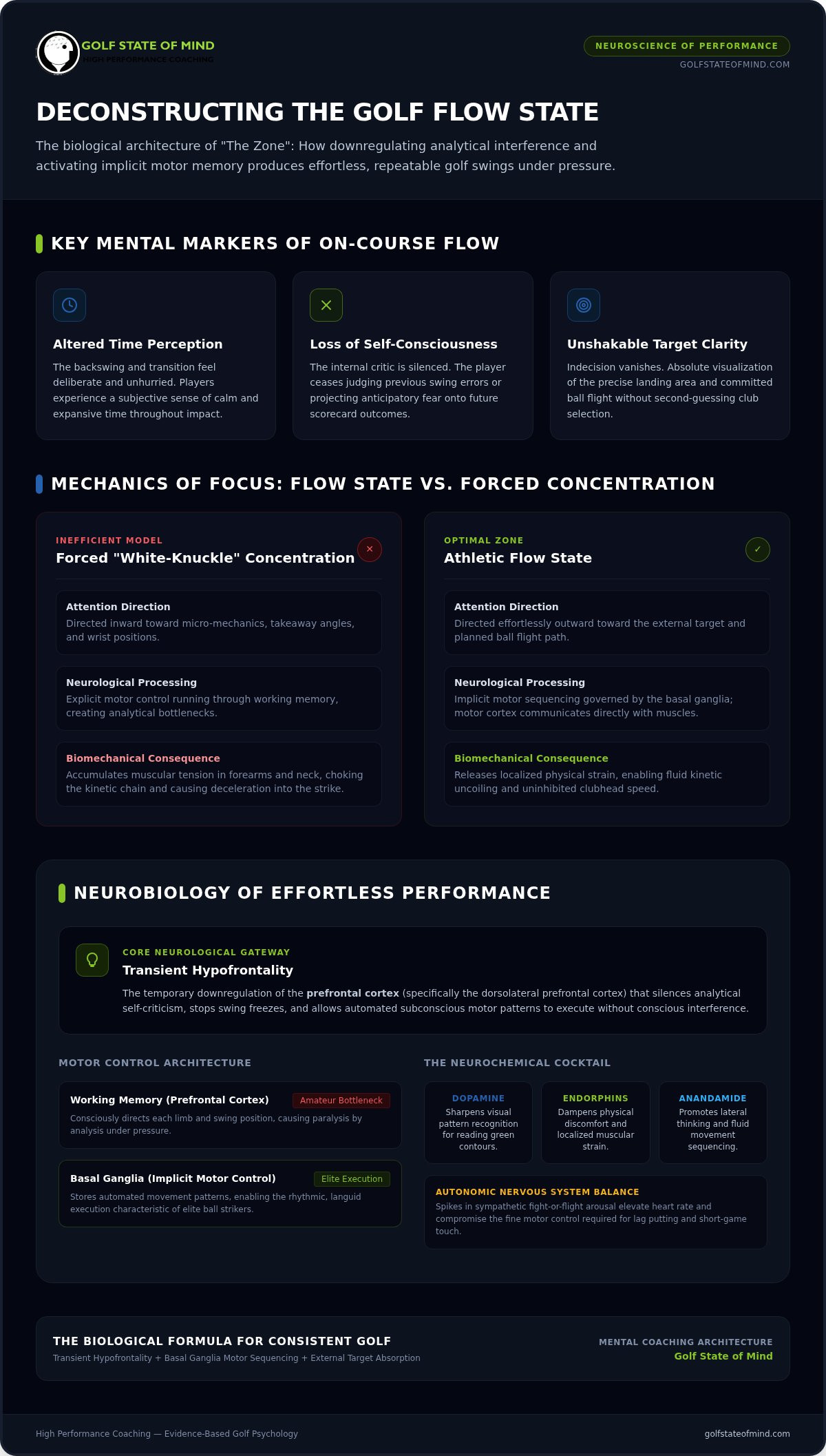
The golf flow state is an experience of becoming deeply absorbed in playing golf, where your attention is closely connected to the task and your actions can feel natural and relatively effortless.
The concept of flow was developed by psychologist Mihaly Csikszentmihalyi, who studied experiences of deep involvement in activities ranging from sport to music and creative work.
In golf, players sometimes describe flow as:
- Feeling completely involved in the shot they’re playing.
- Making decisions without excessive second-guessing.
- Experiencing a natural rhythm to their swing.
- Becoming less concerned with how they look or what others think.
- Feeling that time passes differently than usual.
- Enjoying the challenge rather than constantly judging the outcome.
Not every golfer experiences all these characteristics, and flow doesn’t look or feel exactly the same for everyone.
Researchers have studied characteristics such as focused attention, clear goals, challenge-skill balance, and a sense of involvement. You can read more in this research article on the measurement of flow experiences.
Flow Is Not the Same as Playing Great Golf
One of the biggest misconceptions is that being in the zone automatically means shooting a low score.
Although flow is often associated with enjoyable, effective performance, the experience and the result aren’t the same thing.
You might feel completely absorbed in your game and still hit a poor shot.
You might also shoot a great score without ever feeling particularly relaxed or effortless.
That’s why I wouldn’t recommend judging your mental game by whether you experienced flow during a round.
Instead, evaluate how well you prepared, made decisions, committed to your shots, and responded to the outcomes.
Can You Enter the Golf Flow State on Demand?
Not reliably.
You can create conditions that may make flow more likely, but you can’t guarantee that you’ll experience it whenever you want.
In fact, making flow your primary goal can become another form of outcome thinking.
Imagine standing on the first tee and telling yourself:
I need to get into the zone today. I need to feel completely confident and swing without thinking.
Now, instead of preparing for the tee shot, you’re monitoring your mental state.
Am I relaxed enough? Am I thinking too much? Why doesn’t my swing feel effortless?
You’ve created another set of expectations that may distract you from playing.
A better approach is to ask:
What can I do right now to give myself the best opportunity to play this shot well?
That question directs your attention toward something useful and actionable.
The Association for Applied Sport Psychology’s guide to finding your zone also discusses practical conditions associated with flow, including clear goals, appropriate challenges, and reducing unnecessary distractions.
Five Ways to Create Better Conditions for Flow in Golf
Although you can’t force flow, there are several mental skills you can practice that support greater involvement in the game.
1. Focus on the Shot, Not the Feeling
One of the most useful ways to become more absorbed in golf is to direct your attention toward what you’re doing rather than how you’re feeling.
For example, before a shot, focus on:
- The target you’ve selected.
- The ball flight you’re intending to produce.
- The rhythm or feel of your rehearsal swing.
- The decision you’ve made about how to play the shot.
These are relevant to the task.
By contrast, repeatedly asking yourself whether you feel confident, relaxed, or in the zone shifts your attention toward evaluating your internal state.
You don’t have to feel a certain way to make a committed swing.
Confidence and flow are experiences. Commitment is something you can practice.
2. Match the Challenge to Your Current Ability
One of the ideas commonly associated with flow is the relationship between challenge and skill.
When a task is too easy, you might become bored or disengaged.
When it feels overwhelmingly difficult, you might become preoccupied with the possibility of failure.
Appropriate challenges can help keep you interested and involved.
In golf practice, this means choosing exercises that require attention and effort without being so difficult that you’re simply repeating unsuccessful attempts.
For example, if you’re practicing putting, try setting a challenge that is demanding but achievable for your current ability.
You might attempt to complete a putting ladder, alternate between different distances, or finish a series of putts inside a designated distance-control zone.
As your ability improves, increase the challenge.
The objective isn’t to make every practice session stressful. It’s to create meaningful tasks that keep you engaged and provide useful feedback.
3. Use a Consistent Pre-Shot Routine
A good pre-shot routine gives you a familiar process for preparing and executing shots.
It helps you move from thinking about the shot to playing it.
In my coaching, I teach three phases:
Planning Phase
Assess the situation, choose your club and target, visualize the intended shot, and make a purposeful rehearsal.
This is where you make your decisions.
Athletic Phase
Once you step into the ball, connect with a simple intention, such as the target, ball flight, or rhythm of the swing.
Rather than continually analyzing mechanics, allow yourself to make an athletic movement.
Acceptance Phase
After the shot, acknowledge the result and your reaction.
Take any useful information from it, accept that the shot is finished, and redirect your attention toward what comes next.
Plan the shot. Play the shot. Accept the shot.
Using this process won’t guarantee that you enter a flow state. But it gives you a consistent approach to each shot, regardless of how you’re feeling.
For more detail, see my article on building an effective mental pre-shot routine for golf.
4. Stop Monitoring Every Thought and Feeling
Golfers sometimes believe that playing freely means having a completely quiet mind.
But thoughts are a normal part of playing golf.
You might think about your score. You might remember a poor shot from earlier in the round. You might notice a technical thought just before you swing.
None of these automatically prevents you from playing well.
The difficulty often begins when you become preoccupied with controlling or eliminating the thoughts.
For example:
I must stop thinking about my swing. I can’t have any negative thoughts. I need to feel relaxed before I hit this.
Now your attention is directed toward fighting your own experience rather than playing the shot.
Instead, practice noticing thoughts without treating them as instructions.
You can acknowledge a thought such as Don’t hit it in the water and then return your attention to your chosen target and ball flight.
You don’t need to win an argument with the thought.
You simply need to return to what you’re trying to do.
If this is a recurring challenge, my guide to overcoming mental blocks in golf explores how to respond to doubt and overthinking without becoming caught up in them.
5. Become More Involved in the Game, Not Just the Score
One of the most common things that disrupts a golfer’s attention is becoming overly concerned with the score.
You start thinking about breaking 80, winning a competition, or protecting a good round.
Those goals are meaningful, and there’s nothing wrong with caring about them.
But they aren’t particularly useful things to focus on when you’re preparing to hit a shot.
Instead, direct your attention toward the challenges the course is presenting.
What does this lie require?
Where is the best target?
What shot can I commit to?
How can I respond well if the result isn’t what I wanted?
When you’re involved in solving the challenges of the game, there’s less need to constantly evaluate your overall performance.
This is an important distinction: playing to achieve a good score isn’t the same as thinking about your score throughout the round.
What Prevents Golfers From Playing Freely?
There are several common habits that can make it harder to become absorbed in your game.
| Common Distraction | What Happens | A Better Response |
|---|---|---|
| Too many swing thoughts | You become focused on controlling the movement. | Complete technical work during preparation and use a simple intention when playing. |
| Thinking about the score | Your attention shifts toward future outcomes. | Return to the decision and shot in front of you. |
| Frustration after mistakes | You carry the previous result into your next decision. | Acknowledge, accept, and redirect. |
| Trying to feel confident | You start monitoring whether you’re in the right mental state. | Focus on confident behaviors rather than demanding a feeling. |
| Comparing yourself with others | Your attention moves toward other players’ performances. | Return to your own strategy and Performance Commitments. |
Notice that the solution isn’t to force yourself to become calm or positive.
It’s to develop the ability to redirect your attention toward useful actions.
How to Get Back Into Your Game After Losing Focus
Imagine you’ve been playing well for twelve holes.
Your swing feels natural, you’re enjoying the round, and your attention has been on the shots you’re playing.
Then you look at your scorecard and realize you’re on track for your best round of the year.
Suddenly, everything feels different.
You start thinking about the remaining holes. You become more aware of your swing. You worry about making a mistake.
You might tell yourself that you’ve lost your flow state.
But that label can become another distraction.
Rather than trying to recreate how you felt earlier, use this three-step approach.
Step 1: Notice Where Your Attention Has Gone
Recognize that you’ve started thinking about the outcome or evaluating your performance.
You don’t need to criticize yourself for it.
It’s normal to think about the score when something important is at stake.
Step 2: Accept the Change in Feeling
You might feel nervous or more self-conscious than before.
That’s okay.
You don’t need to recreate the relaxed feeling you had on the front nine.
Trying to recover that feeling can make it harder to focus on what matters.
Step 3: Return to Your Process
Assess the next shot.
Make a clear decision.
Follow your pre-shot routine.
Commit to the shot you’ve chosen.
Then accept the result.
That’s all you need to do.
You might begin to feel absorbed in the game again, or you might continue to feel nervous.
Either way, you can still play effective golf.
For more strategies in these situations, read how to stop choking in golf under pressure.
Three Practice Drills to Help You Play More Freely
You don’t need to wait until your next tournament to work on the mental skills associated with flow.
Here are three practical exercises you can use during practice.
Drill 1: One Ball, One Target, One Routine
On the driving range, avoid hitting the same club repeatedly without changing targets.
Instead:
- Choose a specific target.
- Select a club and intended shot.
- Go through your complete pre-shot routine.
- Hit one ball.
- Observe the result without immediately trying to fix everything.
- Choose a new target or club and repeat.
This makes practice more like playing golf, where each shot requires a fresh decision.
The objective isn’t to hit every shot perfectly. It’s to practice becoming involved in the task and making committed swings.
Drill 2: The Challenge Ladder
Choose a putting or chipping challenge appropriate for your current ability.
For example, place five balls at progressively longer putting distances.
Your goal is to finish each putt within a designated distance-control zone or hole it.
Once you complete the challenge consistently, increase the difficulty slightly.
If the exercise becomes too difficult, adjust it so you’re challenged without becoming overwhelmed.
Focus on the task, your routine, and the feedback each attempt provides.
Drill 3: Play Nine Holes Without Chasing a Feeling
Before a practice round, make one commitment:
I’m going to focus on my process rather than trying to feel confident, relaxed, or in the zone.
Choose three Performance Commitments:
- Make clear decisions before every shot.
- Follow your pre-shot routine.
- Accept each result and redirect your attention.
During the round, notice when you start evaluating how well you’re playing or how you’re feeling.
Then return to the task.
After nine holes, rate your commitments from 1 to 5.
Don’t grade yourself on whether you experienced flow.
Grade yourself on the behaviors you practiced.
Why Your Pre-Round Preparation Matters
Although you can’t guarantee a flow state, arriving at the first tee feeling rushed and unprepared can create unnecessary distractions.
A purposeful pre-round routine gives you time to prepare physically and mentally.
It might include:
- Arriving early enough to avoid rushing.
- Warming up your body and swing.
- Getting a feel for the speed of the greens.
- Reviewing your strategy for the opening holes.
- Visualizing how you’ll respond to common challenges.
- Choosing two or three Performance Commitments.
The goal isn’t to manufacture the perfect feeling before you play.
It’s to give yourself a clear plan and reduce avoidable distractions.
For a practical preparation framework, see my 30-minute pre-round golf routine.
Don’t Make Flow State Another Performance Goal
Here’s the most important point I want you to take from this article.
If you go into every round trying to experience a flow state, you’re placing another expectation on yourself.
You’re telling yourself that you need to feel a certain way to play your best.
But golf doesn’t work like that.
Some days you’ll feel confident and relaxed.
Other days you’ll feel nervous, distracted, or uncomfortable.
Some rounds will feel effortless, while others will require more patience and deliberate attention.
You can still make good decisions and committed swings in all of those situations.
Instead of asking, How do I get into the zone?, try asking:
How can I become more involved in playing the shot in front of me?
That’s a much more useful question.
Build the Mental Skills That Support Better Golf
Learn how to improve your focus, develop a more consistent routine, handle pressure, and respond constructively to mistakes with my free mental game ebook.
Click here to download the free mental game ebook
Frequently Asked Questions About the Golf Flow State
What does being in the zone mean in golf?
Being in the zone describes an experience of deep involvement in playing golf. Your attention is closely connected to the task, decisions may feel natural, and your swing can feel relatively effortless. Not every golfer experiences flow in exactly the same way.
How do you get into a flow state in golf?
You can’t guarantee a flow state, but you can create conditions that may support it. Focus on clear goals, appropriate challenges, a consistent pre-shot routine, and becoming involved in the shot rather than monitoring how you’re feeling.
Can you force yourself into the zone?
No. Trying to force flow can lead to excessive self-monitoring and distraction. It’s more useful to focus on your preparation, decisions, and execution, allowing flow to emerge naturally if it does.
Does being in flow guarantee better golf scores?
No. Flow is a subjective experience, not a guarantee of performance. You can experience flow and still hit poor shots, or shoot a good score without feeling especially effortless. Evaluate your decisions and behaviors separately from the result.
Why do I lose my flow state when I start thinking about my score?
Thinking about your score can shift your attention away from the immediate task and toward future outcomes. When you notice this happening, accept that the score matters to you and return your attention to the next decision and shot.
Can you experience flow while feeling nervous?
Flow doesn’t require a particular level of calmness, and athletes’ experiences vary. Rather than trying to eliminate nerves, focus on the actions that help you prepare and execute your shots. You can play effective golf even when you don’t experience flow.
Should I avoid swing thoughts to get into the zone?
Not necessarily. Technical thoughts can be useful during deliberate practice. During play, many golfers benefit from simplifying their attention to a clear target, ball flight, rhythm, or familiar swing intention. The goal is not to force a completely empty mind.
How long does a golf flow state last?
There is no fixed duration. Some golfers describe brief periods of absorption around individual shots, while others remember extended stretches of a round when play felt natural. You don’t need to maintain uninterrupted flow throughout 18 holes to perform well.
How can I practice the mental skills associated with flow?
Use one-ball practice, varied targets, appropriate challenges, and a consistent pre-shot routine. During practice rounds, evaluate how well you make decisions, commit to shots, and respond to outcomes rather than trying to manufacture a particular feeling.
Final Thoughts: Play the Game, Don’t Chase the Zone
The golf flow state can be one of the most enjoyable experiences in the game.
But it’s not something you need to achieve before you can play well.
Instead of trying to control your thoughts, emotions, or level of confidence, develop the habits that help you become more involved in playing golf.
Make clear decisions. Follow your routine. Connect with the shot you’re trying to play. Accept the result and move on.
Sometimes those habits may contribute to an experience of flow.
Other times, you’ll need to play through nerves, doubt, and frustration.
Both are part of golf.
The goal isn’t to get into the zone on demand. It’s to become the kind of player who can make good decisions and committed swings, whether you’re in the zone or not.
Get your FREE Mental Game Scorecard

Source