

What are your golf goals for the next six months?
Perhaps you want to lower your handicap, break 80 for the first time, win a tournament, or become more consistent under pressure.
Those are all worthwhile ambitions.
But here’s the question I ask golfers when we discuss their goals:
“What are you going to do differently this week to move closer to that goal?”
That’s where many golfers struggle.
They know what they want to achieve, but they haven’t developed a clear plan for getting there.
They practise when they have time, work on whatever feels weakest that day, and judge their progress almost entirely by their scores.
When the results don’t improve quickly enough, they become frustrated.
I’m David MacKenzie, founder of Golf State of Mind. As a golf mental performance coach, I help golfers develop the mental skills, routines, and behaviors that support more consistent performance.
One of the foundations of that work is learning how to set meaningful goals.
In this article, I’ll show you how to choose measurable golf goals, identify what you need to improve, build a realistic practice plan, and track the behaviors that give you the best opportunity to succeed.
Why Most Golf Goals Don’t Lead to Improvement
Imagine two golfers who both want to break 80.
The first golfer writes down:
“My goal is to break 80 this year.”
Then they continue practising as usual.
Some days they hit drivers. Other days they work on their irons. After a bad putting round, they spend an hour on the practice green.
There’s no clear connection between their goal and their weekly actions.
The second golfer also wants to break 80.
But they review their recent rounds and discover that penalty strokes, three-putts, and poor decisions after mistakes are contributing to their higher scores.
They develop a practice plan around those priorities.
They also choose specific mental commitments to follow during every round.
Both golfers have the same outcome goal.
But only one has a clear process for working toward it.
A goal tells you where you want to go. A plan tells you what to do next.
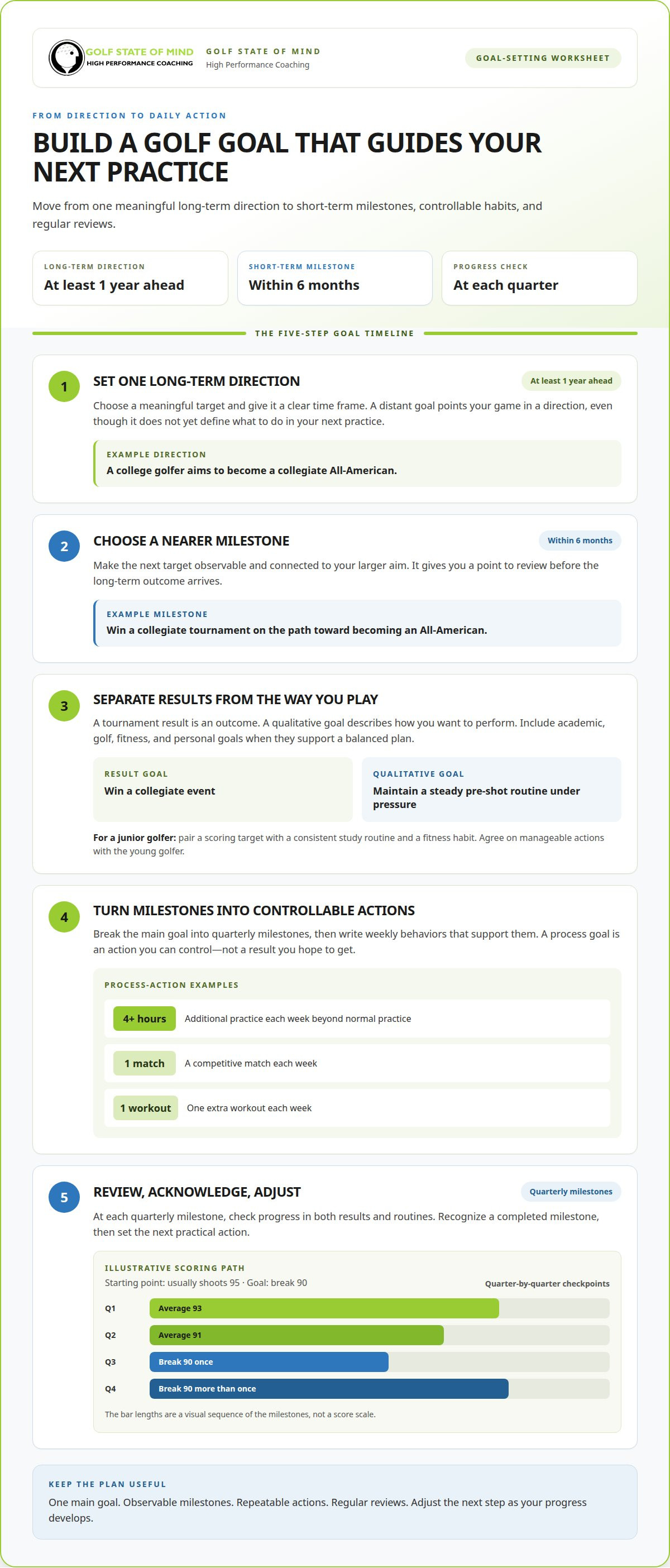
1. Understand the Three Types of Golf Goals
Before choosing your main goal, it’s important to understand the difference between outcome, performance, and process goals.
They serve different purposes, and I encourage golfers to use all three.
Outcome Goals: What You Want to Achieve
Outcome goals describe a result you want.
Examples include:
- Win your club championship.
- Qualify for a particular tournament.
- Earn a place on your high school or college team.
- Finish in the top ten of a competitive event.
Outcome goals can be motivating because they give your efforts direction.
However, you don’t have complete control over them.
You might play exceptionally well and still lose a tournament because another golfer plays better.
That’s why outcome goals shouldn’t be your only measure of success.
Performance Goals: The Standard You Want to Reach
Performance goals describe a measurable standard of your own play.
Examples include:
- Break 80 during a competitive round.
- Reduce your scoring average over a defined period.
- Lower your Handicap Index from 12 to 9.
- Reduce your average penalty strokes per round.
- Improve your putting performance from a particular distance.
These goals help you evaluate progress against your own previous performance.
But they still involve factors you can’t completely control, including course conditions, execution variability, and the occasional bad bounce.
Process Goals: What You Commit to Doing
Process goals are the specific actions and behaviors you want to repeat.
Examples include:
- Follow my mental pre-shot routine before every full shot.
- Choose a clear target before stepping into the ball.
- Complete three purposeful practice sessions each week.
- Respond constructively after a poor shot.
- Complete a post-round review after each competitive round.
These are the goals that guide your daily behavior.
They’re also the goals you have the greatest influence over.
| Goal Type | Example | Main Purpose |
|---|---|---|
| Outcome | Win the club championship | Provide direction and motivation |
| Performance | Reduce scoring average from 84 to 81 | Measure improvement |
| Process | Commit to a clear target before every shot | Guide daily behavior |
Use outcome goals for direction, performance goals for measurement, and process goals for action.
2. Choose One Main Golf Goal
Many golfers make the mistake of setting too many goals at once.
They want to lower their handicap, increase driving distance, improve their putting, become mentally tougher, and win more tournaments.
All of those things may be important.
But if everything is a priority, it’s difficult to decide what deserves your attention.
Start by choosing one main goal for your current planning period.
Ask yourself:
- What improvement would make the biggest difference to my golf?
- Why does this goal matter to me?
- What is my current starting point?
- When would I like to achieve it?
- What evidence would show that I’ve succeeded?
Use the SMART Goal Framework
A useful goal is:
- Specific: You know exactly what you’re trying to achieve.
- Measurable: You can assess whether progress is happening.
- Achievable: It’s challenging but grounded in your circumstances.
- Relevant: It matters to your development as a golfer.
- Time-bound: You have a defined period for working toward it.
For example, instead of:
“I want to become a better golfer.”
Try:
“Over the next six months, I want to reduce my average score from 88 to 84 across my most recent ten comparable rounds.”
That’s a measurable performance goal.
Now you can begin building the process that supports it.
Remember that the timeline is a planning tool, not a guarantee. Progress may be uneven, and you can adjust the plan as you learn more.
3. Assess Your Current Golf Game Before Building a Plan
One of the biggest mistakes golfers make is choosing practice priorities based entirely on their most recent round.
They hit one bad drive and decide they need to fix their driver.
They miss two short putts and conclude that putting is their biggest weakness.
But one round doesn’t always reveal the most important pattern.
Before creating your practice plan, review a representative sample of recent rounds.
Ten rounds can provide a useful starting point if you have that many available, but you can begin with fewer and update your assessment as you collect more information.
Look for Patterns, Not Just Scores
Consider tracking:
- Scores and course difficulty.
- Penalty strokes.
- Three-putts and putting performance.
- Missed greens and the resulting recovery shots.
- Unforced course-management mistakes.
- Shots played without full commitment.
- Emotional reactions that affected subsequent decisions.
Don’t collect statistics simply because they’re available.
Choose measures that help explain the gap between your current performance and your goal.
Example: A Golfer Trying to Break 90
Suppose a golfer regularly shoots between 92 and 98.
After reviewing several rounds, they notice three recurring problems:
- They average several penalty strokes because of overly aggressive targets.
- They frequently leave themselves difficult second putts.
- After a poor hole, they rush their next tee shot.
Now they have a much clearer plan.
Instead of trying to improve everything, they can work on course management, putting pace, and their response to mistakes.
That’s far more useful than simply telling themselves to concentrate harder.
4. Identify Your Two or Three Biggest Opportunities
Once you’ve assessed your game, choose two or three priorities that are most relevant to your main goal.
These might be technical, strategic, physical, or mental.
For example:
| Current Pattern | Practice Priority | Measurable Action |
|---|---|---|
| Frequent penalty strokes | Course management | Choose a target and identify the main risk before tee shots |
| Poor distance control | Putting pace | Complete a distance-control drill twice weekly |
| Indecision over the ball | Pre-shot routine | Record routine commitment during rounds |
| Frustration after mistakes | Emotional recovery | Use a consistent reset after disappointing shots |
The point is to connect each weakness to something you can practise.
For mental performance, avoid goals such as:
“Be more confident.”
That’s difficult to measure consistently.
Instead, define what confident behavior would look like.
For example:
“I will make a clear decision and commit fully to my chosen target before every tee shot.”
Now you have a behavior you can observe and review.
5. Create Four Mental Performance Commitments
This is where I would add something particularly important to your golf goal-setting plan.
Most golfers set goals around scores, handicaps, and tournament results.
But they rarely measure the mental behaviors that support those outcomes.
That’s why I encourage golfers to establish four Performance Commitments.
These are specific, controllable behaviors you intend to follow during your rounds.
Example Performance Commitments
- Decision-making: I will choose a clear target and shot before addressing the ball.
- Routine: I will follow my mental pre-shot routine.
- Commitment: I will give each shot my full commitment, even when I feel uncertain.
- Acceptance: I will respond constructively to the outcome and refocus on the next shot.
These commitments help you evaluate your performance in a different way.
You might shoot 85 and execute your mental process exceptionally well.
Or you might shoot 78 while repeatedly making indecisive decisions and reacting poorly to mistakes.
Your score matters, but it doesn’t tell the whole story.
Use a Mental Scorecard
After each hole, award yourself one point for each commitment you followed consistently on that hole.
That’s a maximum of four points per hole, or 72 points for an 18-hole round.
For example, suppose you earn 61 points.
Your Mental Scorecard percentage would be:
61 ÷ 72 × 100 = 84.7%
Now you have a measurable indicator of how consistently you’re following your chosen mental behaviors.
Over time, look for patterns.
Perhaps your routine remains strong throughout the round, but your commitment drops when you’re trying to protect a good score.
That’s a specific skill you can address in practice.
The Mental Scorecard helps you measure how you played mentally, not just what you scored.
6. Build a Weekly Golf Practice Plan You Can Actually Follow
Once you’ve chosen your priorities, the next step is deciding when and how you’ll practise them.
Start with your real schedule.
How much time can you consistently dedicate to golf?
It’s better to complete three purposeful sessions each week than create an unrealistic plan requiring practice time you don’t have.
Example Weekly Golf Practice Plan
Here’s an example for a golfer who can practise three times and play once per week.
| Day | Activity | Main Focus |
|---|---|---|
| Monday | 45-minute range session | Technical priority followed by performance practice |
| Wednesday | 30-minute putting session | Distance control and pressure putting |
| Friday | 30-minute short-game session | Recovery shots and varied lies |
| Weekend | 18-hole round | Four mental Performance Commitments |
| After the round | 10-minute review | Record patterns and next steps |
This is only an example.
A junior tournament golfer may have considerably more practice time.
A working parent may only have two short sessions available.
Both can create effective plans.
The important thing is that each session has a purpose connected to the larger goal.
Use Practice and Performance Modes
I also encourage golfers to separate technical practice from performance practice.
During technical practice, you can work deliberately on swing mechanics.
During performance practice, change clubs and targets, use your full routine, and commit to one shot at a time.
This helps prepare you for the demands of the golf course, where you don’t get unlimited attempts at the same shot.
7. Set Short-Term Milestones Without Becoming Obsessed With Results
Long-term goals can feel overwhelming if they’re too far away.
That’s why it helps to divide them into smaller milestones.
For example, suppose your six-month goal is to reduce your average score from 88 to 84.
Your milestones might look like this:
| Period | Milestone | Process Focus |
|---|---|---|
| Month 1 | Establish baseline statistics | Track scoring patterns and mental commitments |
| Months 2–3 | Reduce recurring costly mistakes | Practise course management and targeted skills |
| Months 4–5 | Improve consistency across rounds | Transfer practice skills to the course |
| Month 6 | Evaluate scoring average against the goal | Review results and build the next plan |
Notice that the milestones aren’t all score targets.
Some are about gathering information, improving habits, and becoming more consistent.
That’s intentional.
Golf improvement doesn’t always follow a straight line.
You may practise well for several weeks without seeing an immediate reduction in your scores.
That doesn’t necessarily mean your plan isn’t working.
Review the evidence before making changes.
8. Review Your Goals Without Judging Yourself After Every Round
One of the biggest challenges with goal setting is learning to evaluate progress objectively.
Golfers often overreact to their latest score.
After a good round, they believe everything is working.
After a bad round, they question the entire plan.
But meaningful progress is usually better assessed across multiple sessions and rounds.
After Every Round: A Short Review
Ask yourself:
- What did I do well?
- Where did I lose shots?
- How consistently did I follow my Performance Commitments?
- What did I learn?
- What’s one thing I want to improve before my next round?
Keep the review constructive.
The purpose isn’t to criticize yourself.
It’s to gather information that helps you prepare more effectively.
Every Month: Review Your Progress
Look at your recent scores, practice sessions, and mental-performance records.
Ask:
- Am I completing the practice I planned?
- Are my priority skills improving?
- Am I making better decisions on the course?
- Are my mental commitments becoming more consistent?
- Does the plan need adjusting?
Try not to change everything at once.
Identify the most useful adjustment and continue.
9. Don’t Let Your Golf Goals Become a Source of Pressure
There’s an important psychological challenge with goal setting.
Goals can motivate us.
But they can also become a source of anxiety when we become overly attached to achieving them.
Imagine you’re trying to break 80.
You reach the 16th tee at two over par.
Suddenly, you realize you’re on track to achieve your goal.
Now your thinking changes.
“Don’t mess this up.”
“I can’t afford a double bogey.”
“I’ve got to finish well.”
You’re no longer focused on playing the next shot.
You’re trying to protect the result.
I call this a protection mindset.
Instead of playing freely and committing to your decisions, you become focused on avoiding failure.
Use Goals Before and After the Round, Not During Every Shot
Here’s how I want you to think about your goals:
Before the round: Review your preparation and Performance Commitments.
During the round: Focus on the shot in front of you.
After the round: Evaluate your process and progress.
Your goals should guide your preparation.
They shouldn’t become another distraction while you’re competing.
Set ambitious goals, but stay committed to the present moment.
Golf Goal-Setting Worksheet: Build Your Own Plan
Use the following worksheet as a starting point. You can copy it into a notebook or document and complete it before your next practice session.
Part 1: My Main Goal
My primary golf goal: ______________________________
Why this goal matters to me: ______________________________
My current performance level: ______________________________
My target performance level: ______________________________
My review date: ______________________________
Part 2: My Biggest Opportunities
Priority 1: ______________________________
Priority 2: ______________________________
Priority 3: ______________________________
Part 3: My Weekly Actions
Practice session 1: ______________________________
Practice session 2: ______________________________
Practice session 3: ______________________________
On-course focus: ______________________________
Part 4: My Four Mental Performance Commitments
Commitment 1: ______________________________
Commitment 2: ______________________________
Commitment 3: ______________________________
Commitment 4: ______________________________
Part 5: My Progress Review
What improved? ______________________________
What remains challenging? ______________________________
What did I learn? ______________________________
What will I adjust next? ______________________________
Keep this worksheet somewhere accessible.
Review it regularly, and update it when you have enough evidence to make an informed decision.
Golf Goal Setting for Junior Players
Goal setting is particularly valuable for junior golfers, but it needs to be approached thoughtfully.
Young players can easily become overly focused on rankings, scores, and tournament results.
Parents and coaches can help by encouraging goals that emphasize learning, effort, and controllable behaviors.
For example, a junior golfer might have an outcome goal of making the high school team.
But their weekly process goals might include:
- Completing purposeful practice sessions.
- Following their pre-shot routine during rounds.
- Responding constructively after mistakes.
- Maintaining a healthy balance between golf, school, and other activities.
Encourage junior players to take ownership of their goals.
Ask what they want to achieve and why it matters to them.
Then help them identify actions that are realistic for their age, development, and schedule.
The objective is to develop motivated, resilient golfers—not make every round feel like a test of their worth.
Frequently Asked Questions About Golf Goal Setting
What are good golf goals for beginners?
Good beginner goals include developing a consistent pre-shot routine, completing regular purposeful practice, improving basic contact, reducing penalty strokes, and learning to make sensible course-management decisions. Choose goals that match your current ability and available practice time.
What are examples of SMART golf goals?
An example is: “Over the next three months, I will complete two putting practice sessions each week and track my distance-control performance.” Another is: “Over the next six months, I want to reduce my average score from 95 to 90 across comparable rounds.”
What’s the difference between outcome and process goals in golf?
Outcome goals describe what you want to achieve, such as winning a tournament. Process goals describe actions you can perform, such as following your routine and committing to your target. Both can be useful, but process goals guide your daily behavior.
How many golf goals should I set?
Start with one main goal and two or three supporting priorities. You can have other ambitions, but keeping your current plan focused makes it easier to decide what deserves your practice time.
How often should I review my golf goals?
Complete a brief review after rounds and a more detailed review approximately once a month. Longer-term goals can be reassessed at the end of a defined training period. Avoid changing your entire plan because of one unusually good or bad round.
Should my golf goals focus on score or handicap?
Score and handicap can be useful performance measures, but they shouldn’t be your only goals. Pair them with process goals that address the decisions, skills, and habits most likely to support improvement.
What should a golf goal-setting worksheet include?
Include your main goal, current baseline, target, review date, priority skills, weekly practice actions, mental Performance Commitments, and space for reviewing progress.
How can I stay motivated when my golf scores aren’t improving?
Look beyond the score. Review whether your practice is consistent, whether specific skills are improving, and whether your decisions and mental routines are becoming more reliable. If progress remains limited, use the evidence to adjust your plan rather than assuming you need to work harder at everything.
Final Thoughts: Turn Your Golf Goals Into Daily Actions
Setting a golf goal is easy.
Creating a plan that supports it requires more thought.
Start with one meaningful goal.
Understand your current performance.
Identify the skills and behaviors that deserve your attention.
Build a practice schedule you can consistently follow.
And measure your progress through both results and controllable actions.
Most importantly, remember that your goals are there to guide your development, not define your worth as a golfer.
Use your goals to decide how to prepare. Then, when it’s time to play, focus on the next shot.
That’s how you turn an ambition into a practical mental game plan.
Make Your Mental Game Part of Your Improvement Plan
Download my free mental game ebook for practical techniques to improve focus, confidence, commitment, and emotional control on the golf course.
Click here to download the free mental game ebook
Get your FREE Mental Game Scorecard

Source